Wednesday, 14 October 2009

New build Midwife led units and Birth Centers


I have been lucky enough to visit a birth Center in the South West of England and a newly built Midwifery led unit (Co-located) in the North of England, in the last few weeks.
I was looking forward to seeing what they had done with the birthing rooms, as they had a 'blank slate' (so to speak).
Sadly I was dissapointed with both centers.
Whilst the rooms were clean and bright (and I could argue that dim might be better!) they were hardly 'fit for purpose' to encourage normal labour, mobilisation etc
In the new MLU the rooms were a good size, but still had hospital delivery beds and resusitaires (I was told these were going to be moved out soon)
Its a same that even in these new builds health professionals are not being more innvative in the design.
We are currently in the process of writing up a paper for publication so will post details when this is finalised.

Wednesday, 2 September 2009

Arts and Health Conference

We will be presenting our work on collaberation for Maternity room design at the University of Northampton Arts and Health Conference - Inspiring Transformations on September 10th.
http://www.northampton.ac.uk/artsandhealth/

Thursday, 4 June 2009

Conference

I will be presenting my dissertation "The Incidence of Women giving birth in Liverpool in 2005-07 having a ‘Physiological Birth’ as compared to ‘Normal Births’ and ‘Cephalic Vertex Births’: Are there differences in health outcomes for mothers and babies by type of birth?"
Next wek on Friday June 12th at the Normal Labour and birth 4th Research Conference at Grange over Sands.


Thursday, 28 May 2009

A Space to Give Birth in event 2


Deverra and LJMU ran another fantastic event at the Climate for Change experiment at FACT, Liverpool on May 18th.
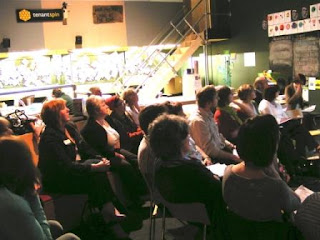
This day focused on gathering the views of health professionals on the need for change in Maternity room design and it had a great turnout with over thirty Midwives, Managers, Architects, Designers and students from around the North West.

The day sparked off lots of interesting debates and discussions and I will posting up some of the presentations, photographs, videos and feedback from the event in the next few weeks.
The day started with a delicious breakfast of fruit and juice.

We then presented the work from the previous event and summarised some of the work we have been doing, looking at innovative maternity room design.


We showed a film with footage from the first 'A Space to give Birth in' event in March, both filmed and edited by Neringa Plange ( http://neringaplange.wordpress.com/)

We also had a presentation from the National CHildbirth Trust about their, 'Better Birth environment' campaign.

We had a really interesting talk from Aquabirths (http://www.aquabirths.co.uk/) about designing bespoke birthing pools and we were all inspired by their enthusiasm and the possibilities for new and exciting pools that could be used within UK maternity units.

During lunch we had Gafro (http://www.gafro.com/GAFRO/HOME.html) a very talented percussionist, from the Liverpool Lark Lane Drummers group, run a workshop on African drumming, he introduced us to a rhythm which is used culturally to ease childbirth and I thought it was interesting to feel the mood change as the powerful, melodic music was heard throughout the FACT building, As we played, the music also depicted the changes of rhythm that women experience in Labour, from fast to slow, relaxed, to invigorated.


It also reminded us, that for many women birthing for the first time, they are unsure, feel uncomfortable or they 'don't know how to do this' or lose their way (I think anyone joining in with the workshop could agree that we all lost the way rhythmically many times) but with a skilled and non judgemental facilitator (or musical midwife) we were able to rejoin the rhythm and enjoy the experience!
After lunch we facilitated a group discussion exploring ideas about ideal birth environments and how we can move actual maternity room design towards this ideal within the UK.

The findings from the discussion will be posted in the next few days, and make very interesting reading and have given us lots of ideas about ways to move this project forward.

Next we had a presentation from Bianca Lepori (Rome), Architect and author of ‘Architecture Inside Out’, prioritising human needs in design of spaces, she specialises in redesigning birthplaces and furniture to meet women’s psycho-physiological needs in birth.

She introduced us to the ways in which women move and inhabit space when in labour and how maternity design can facilitate this need for movement.


Marc O’ Riain (Cork), Interior designer of an award winning maternity room at Cork University Maternity Hospital presented his design process for a hospital which was designed to be 'More like a hotel than a hospital'.
I found it really interesting that the designers interviewed people about their time in hospital, their fears about the clinical feel of the space and an over riding feeling that pregnancy is not an illness!


I found it very inspiring that the designs were implemented in a functioning hospital and are currently being used by labouring women in Cork, they are truly an example of innovative design!


Findings from the day will be published in the near future, and a second film produced from the footage of this second event (massive thanks to Marc Mcdermott http://services.creativecow.net/s/596/mcmedia for his filming)

I want to thank everyone for coming, sharing your expertise and creating a thought provoking and inspiring event.


Wednesday, 6 May 2009

Sensory rooms

As part of our research we visited a Multi-sensory (Snoezelen) room. These rooms are designed to deliver stimuli to various senses, using lighting effects, color, sounds, music, scents, etc.
They are usually used for children with learning difficulties and autism, but some research has recently been done on the use of Snoezelen rooms to give birth in.

This was a qualitative study, with in depth interviews of sixteen women that used Snoezelen rooms to give birth in.

The findings of the study found six themes from the data which providing insight into what a Snoezelen environment can offer a labouring woman: distraction; relaxation; comfort; environmental control; choice of complementary therapies; and safety in a home-like atmosphere.

Additional categories revealed factors that facilitated and/or detracted use of the room such as familiarity with features, being offered information and choice, timing in labour, the support person's response and working order of the room's features.

Reference

Women's experiences of using a Snoezelen room during labour in Western Australia,
Yvonne Hauck, Catherine Rivers, Kathleen Doherty, MidwiferyVolume 24, Issue 4, December 2008, Pages 460-470
 
Creative Commons License
This work is licenced under a Creative Commons Licence.